Leaving the Armed Forces: Your Resettlement Guide

Leaving the Armed Forces is one of the biggest transitions you will make and unlike most of your career so far, no one hands you a joining instruction for it. There is funding you are entitled to, deadlines that matter, and a resettlement process. But it only works in your favour if you start early and understand what is actually on offer.
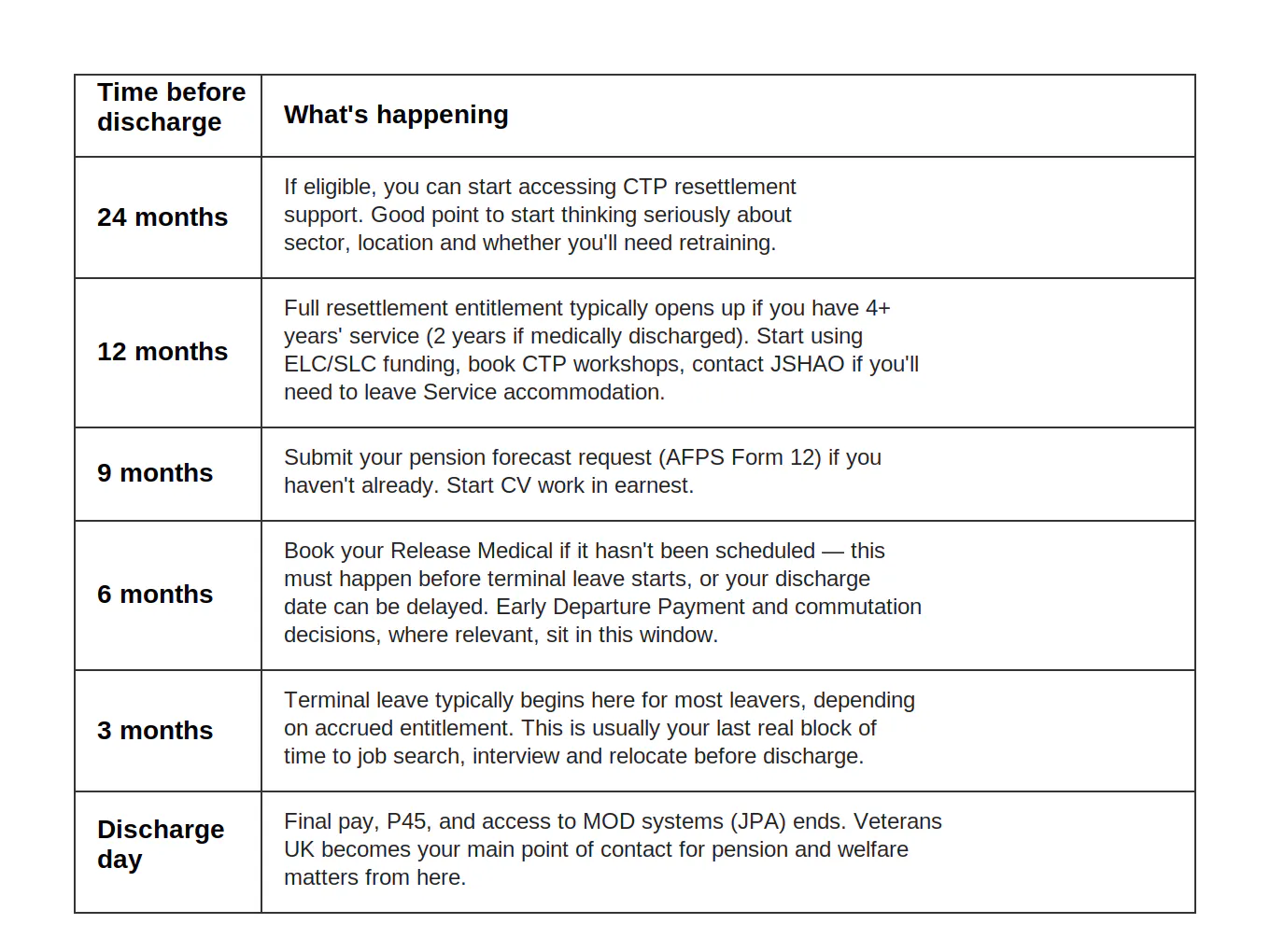
If you take nothing else from this page: resettlement works best in reverse. Most of the funding, training and job-search support available to you is time-limited and tied to your discharge date, not to how ready you feel. The single most useful thing you can do today is work out how many months you have left and check that against the timeline below. Exact entitlements and timings depend on your service length, scheme and reason for leaving, this table is a general guide, not a substitute for your unit's resettlement briefing.
The Resettlement Timeline: What to Do and When

The Schemes You Need to Know About
Enhanced Learning Credits (ELC)
ELC is funding toward a nationally recognised qualification, Level 3 or above, delivered as a single payment in each of up to three separate financial years, worth up to £2,000 a year depending on your tier. It cannot be used for adventure training, battlefield tours, or professional body membership, and courses must go through an approved ELCAS provider. Most people only get one shot at using it well, so it is worth planning what you want to study before you claim.
Standard Learning Credits (SLC)
SLC is a smaller, annual refund scheme, up to £175 a year, covering 80% of course costs, reset every 1 April with no carry-over. It is meant for shorter courses, workshops and professional development that don't need a Level 3+ qualification to justify them, and it cannot be stacked with ELC on the same course.
The Career Transition Partnership (CTP)
CTP is the MOD's official resettlement provider, and for most service leavers it is the default route into civilian employment support, workshops, a career consultant, a jobs board, and an interview simulator through myPlan. It is free, and for many people it is genuinely worth using in full. But it is not the only route, and it works best as one part of your job search rather than the whole strategy.
Terminal Leave
Terminal leave is the block of paid leave you take at the end of your service, calculated from your accrued entitlement, broadly, one day for every completed month of reckonable service, up to a cap. You remain subject to Service law until your actual discharge date, but in practice this is your window to job search, relocate and handle admin without duty commitments in the way.
Pay and Pension When You Leave
Your final Service pay stops on your discharge date, and from that point Veterans UK — not JPA — becomes your point of contact for pension matters. Whether you receive an immediate pension, a preserved pension, or Early Departure Payments depends on your scheme, age and length of service. Requesting a pension forecast early is the single most useful thing you can do to plan your finances around leaving.
Beyond Funding: The Rest of Resettlement
Money and training are only part of it. The rest of resettlement tends to fall into three areas:
- Housing — if you're in Service Family Accommodation or SLA, contact the Joint Service Housing Advice Office (JSHAO) at least 12 months out. Read our Leaving Service Accommodation guide.
- CV and interview prep — translating your rank, role and responsibilities into language a civilian employer will actually understand.
- Sector-specific routes — some industries have well-established pipelines for ex-military talent, with structured entry points and Forces-friendly employers actively recruiting.

Frequently Asked Questions
When should I start my resettlement process?
As early as you're eligible, for most people that's 24 months before discharge for initial CTP access, and 12 months out for full entitlement. Starting early gives you more time to use ELC across multiple financial years and to plan training around a real career goal, not just whatever is available last-minute.
What's the difference between ELC and SLC?
ELC funds higher-level qualifications (Level 3+) with larger payments across up to three financial years. SLC is a smaller annual refund scheme for shorter courses and professional development, capped at £175 a year. You cannot use both on the same course.
Do I have to use CTP?
No, but most eligible service leavers do, because it's free and gives structured access to a career consultant, resettlement workshops and a dedicated jobs board. Some people combine it with independent job searching, industry-specific programmes, or direct applications to Forces-friendly employers.
How much terminal leave will I get?
It depends on your accrued entitlement, broadly calculated from your length of reckonable service. Your unit HR or admin office can confirm your exact terminal leave dates once your discharge date is set.
Will I lose my pension if I leave before pension age?
Not necessarily. If you don't qualify for an immediate pension or Early Departure Payment, your pension is preserved, held until you reach pension age, rather than lost. Rules differ by scheme, so a pension forecast from Veterans UK is worth requesting early. Read our Pensions Guide.
What happens to my Service accommodation when I leave?
You typically have a limited window (often 93 days) to leave Service Family Accommodation or SLA after discharge, though this varies by circumstance. Contact JSHAO as early as possible, ideally 12 months before your discharge date.
Where to Get Free, Trusted Resettlement Support
- Career Transition Partnership (CTP) — the MOD's official resettlement provider for eligible service leavers.
- ELCAS — administers Enhanced Learning Credits claims and approved learning providers.
- Veterans UK — pension forecasts, preserved pensions, and post-discharge welfare queries.
- JSHAO — free, confidential housing advice for those leaving Service accommodation.
- The Royal British Legion — welfare, financial and transition support for the wider Armed Forces community.
Explore all careers support for the Armed Forces community on Troopr's Work & Careers Hub
Related reading
- Pensions Guide — the full breakdown of AFPS schemes, forecasts and preserved pensions
- Leaving Service Accommodation — JSHAO timelines and what happens to SFA/SLA after discharge
- CV Writing & Transferable Skills — translating rank and role into language civilian employers understand
- Mental Health & Wellbeing After Service — support for the transition beyond the practical admin
This page is intended as general guidance only and does not constitute financial, legal, pension or welfare advice. Entitlements, timings and eligibility criteria vary by service length, scheme and individual circumstances. Before making any decisions, speak to your unit's resettlement staff, a qualified financial adviser, or the relevant official body (CTP, Veterans UK, JSHAO) for guidance specific to your situation.