Translate Your Military Skills for Civilian Employers
How to identify, translate and present your transferable skills after the Forces
What Employers Actually Hire You For (Hint: It’s Your Skills, Not Your Rank)
There’s a world of opportunity waiting for you in civilian life. Employers actively look for people from the Armed Forces because you bring something they struggle to find: reliable, values-driven people who get things done.
But here’s the catch:
Most civilian hiring managers don’t understand military roles, ranks or jargon. They will, however, understand:
- Leadership
- Problem solving
- Calm under pressure
- Planning and organisation
- Communication
- Teamwork
This page helps you bridge that gap by:
- Identifying your transferable skills
- Translating both your hard skills (qualifications, technical ability) and soft skills (how you operate)
- Turning your Service experience into clear, civilian-friendly language
- Translating your job titles, ranks and military terms
Use this guide alongside your CV and interview prep so everything tells the same story.
Quick Checklist – Turn Your Service Skills Into Civilian Skills
Use this as your roadmap:
- Identify your transferable skills (hard and soft)
- Translate those skills into civilian language
- Explore your military experience and pull out stories that prove your skills
- Translate your job titles, rank, qualifications and jargon
- Turn all of this into CV bullet points and interview answers
Keep this in front of you while you work through the rest.
Step 1 – Identify Your Transferable Skills
Start by jotting down every skill, qualification and experience you can think of. Don’t filter yet. Think across:
- Roles you’ve held
- Teams you’ve led or been part of
- Operations, exercises, deployments, courses
- Side responsibilities (welfare, training, projects, events)
Remember: not all of your skills will be obvious from your job title.
If you managed a troop, you didn’t just “lead people” – you:
- Planned work
- Designed and delivered training
- Managed conflicting priorities
- Solved day-to-day problems
- Reported to senior leaders
Now split what you have into hard skills and soft skills.
Hard skills (examples)
These are specific abilities or qualifications that can be measured or certified:
- Degrees and academic qualifications
- Industry certifications
- IT and communications skills
- Foreign languages
- Security qualifications
- Budget / fund management training
- Project / risk management qualifications
- Health & Safety / ISO / cyber / technical courses
Soft skills (examples)
These are how you operate – often more important to employers than your technical skills:
- Values-driven and trustworthy
- Analytical and good at problem solving
- Able to work calmly under pressure
- Strong interpersonal skills
- Negotiation and influencing
- High work ethic and standards
- Team skills and collaboration
- Leadership
- Adaptability and resourcefulness
You’ll already have many of these. The job now is to pull them out deliberately.
Step 2 – Use Scenarios to Uncover Your Soft Skills
Soft skills are personal. There’s no one template. So instead of guessing, work from real situations.
Think about times when you:
- Negotiated with different stakeholders
- Reacted to an incident as part of a team
- Took the lead on a problem
- Delivered a project or event
- Planned and executed a mission or exercise
- Helped a colleague through a personal or professional issue
- Challenged something because it was wrong
- Found resources or people quickly to solve a problem
For each scenario, ask: “What skills did I actually use here?”
A few examples:
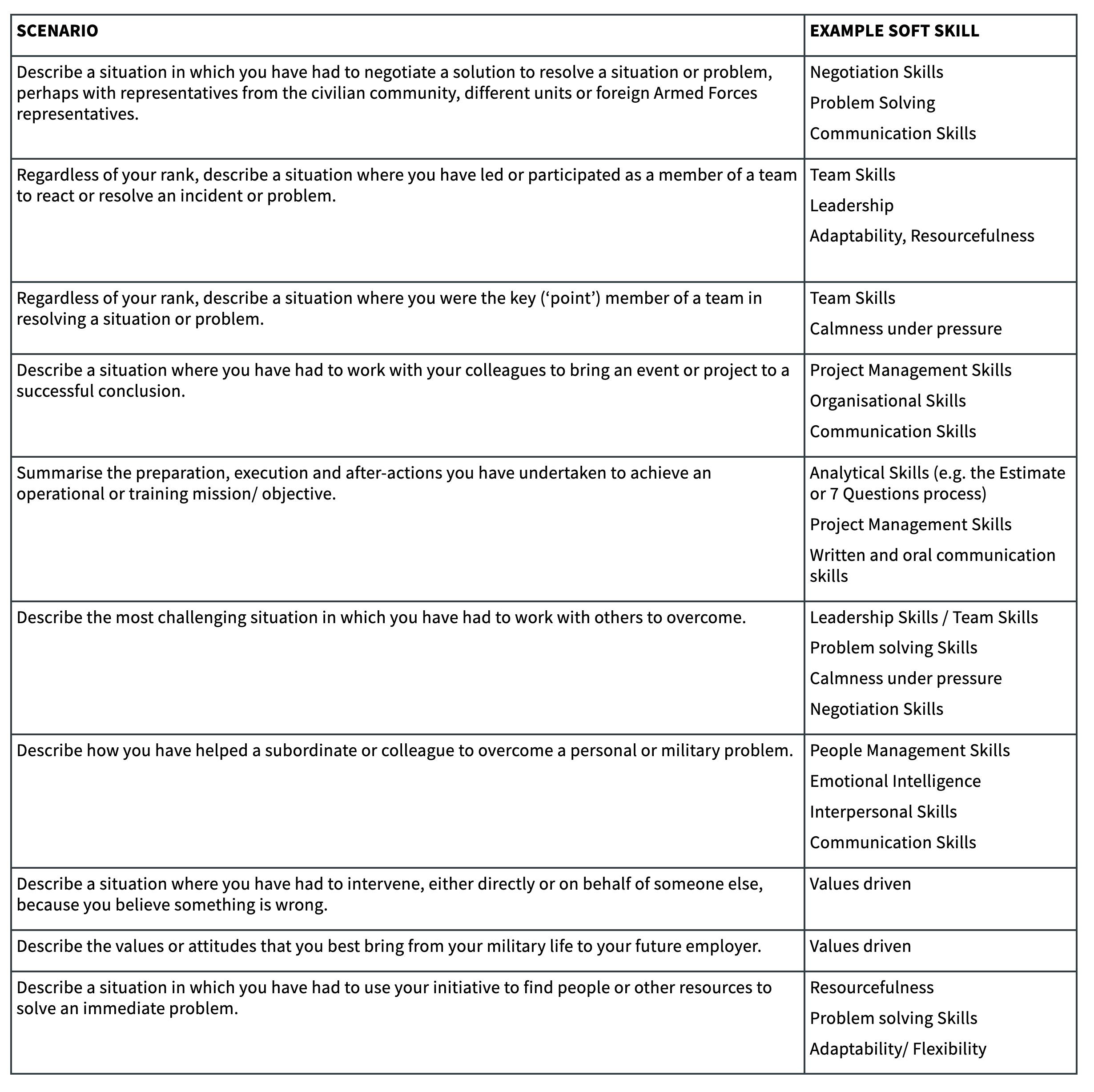
These examples become the raw material for your CV bullets and interview stories.
Step 3 – Translate Your Hard and Soft Skills Into Civilian Language
Now you’ve got a list of skills and scenarios, strip out the military language.
Drop the terminology, keep the function
Ask yourself:
- What was my role in plain English?
- What was the function of my job?
- What skills did I use to get it done?
Examples:
- “Senior NCO / Warrant Officer” → “Team Leader”, “Department Manager”, “Operations Supervisor”
- “Submarine Intrusion Analyst” → “Analyst working with complex computer systems and communications, including cryptology and data interpretation”
Focus on function and impact, not rank and branch.
If something feels “too military”, ask:
“If I described this to someone who’s never met anyone from the Forces, would they understand what I did and why it matters?”
If not, rewrite it.
Step 4 – Explore Your Military Experience (Without Scaring Civvies)
Your experience is as valuable as your skills – but you need to frame it carefully.
People who’ve never served have no idea what “8 years in the Royal Marines” or “3 tours of Afghanistan” actually means. Some may find it intimidating if you describe graphic detail or “war stories”.
So:
- Use operations and deployments as context, not the main event
- Pull out the skill you’re trying to demonstrate (negotiation, teamwork, decision-making, leadership, resilience)
- Talk about the conditions (e.g. multiple stakeholders, language barriers, tight timelines, conflicting priorities) rather than the combat detail
For example, instead of:
“We were surrounded by rival tribal leaders in 54-degree heat in Afghanistan…”
Use:
“I negotiated a solution between multiple groups with conflicting priorities, working through interpreters in a high-pressure environment. It required calm decision making, clear communication and building trust quickly.”
If you can handle that, you’ll be fine in a boardroom in Milton Keynes.
Step 5 – Translate Your Job Titles, Ranks and Jargon
This is where you get practical. It also helps you judge what level of role to go for when you leave.
Job title translations (examples)
- Operations Officer → Operations Manager / Supervisor
- Accounting Officer → Finance Manager
- Intelligence Officer → Research / Intelligence Analyst
- Squadron / Platoon Leader → Team Leader / Department Manager / Director (depending on level)
- Commander → Senior Manager / Director
- Senior NCO → Supervisor / Manager
- Sergeant → Team Leader / Manager
- Supply Sergeant → Logistics Manager / Supply Chain Coordinator
Rank translations (rough level mapping)
- Lance Corporal → Assistant Supervisor / Team Leader
- Corporal → Supervisor / Manager
- Warrant Officer / Sergeant Major → Senior Supervisor / Department Manager
- Major → General Manager / Senior Manager
- Brigadier → Senior Leader / Director / Managing Director
These don’t have to be exact – they’re there to help employers place you.
Jargon translations
Swap military terms for language employers use:
- Combat → hazardous or challenging environments
- Tank → operational vehicle
- Reconnaissance → data collection / information gathering
- Mission → project / task / objective
- Subordinate → team member / employee
- Squadron / Platoon → team / department
- Company (in Army sense) → department / business unit
- Weapons → mechanical / electronic equipment
- Ammunition → supplies / stock
- Radar / Sonar → sophisticated electronic systems
If in doubt, go back to: What was I actually doing and what does that look like in civilian work?
Take Your Next Step
Translating your military background properly takes time – but it’s time well spent. By doing this work now you:
- Get clear on what you offer
- Make it easier for employers to understand your value
- Save time when writing CVs and applications
- Walk into interviews far more prepared
Use your new, translated skills to:
- Update your CV
- Refresh your LinkedIn profile
- Prepare interview examples
Download the Skills Translation Workbook
Use it to capture your skills, scenarios and translations in one place, ready to plug into CVs and interviews.
